
Abstract
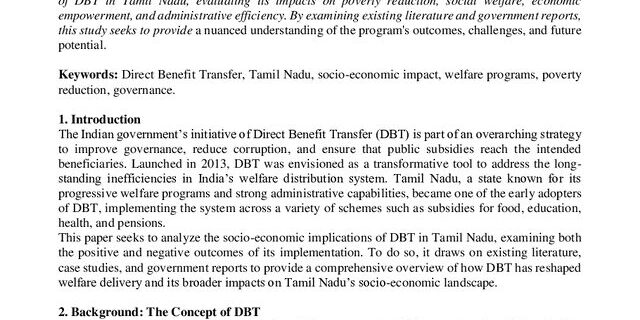
The introduction of Direct Benefit Transfer (DBT) in India marked a significant shift in the country’s welfare delivery system. DBT aims to streamline the disbursement of government subsidies directly to the beneficiaries, bypassing intermediaries to reduce leakage, enhance efficiency, and promote transparency. Tamil Nadu, one of India’s most economically significant states, adopted DBT to ensure that subsidies reach the most marginalized sections of society. This paper explores the implementation of DBT in Tamil Nadu, evaluating its impacts on poverty reduction, social welfare, economic empowerment, and administrative efficiency. By examining existing literature and government reports, this study seeks to provide a nuanced understanding of the program’s outcomes, challenges, and future potential.
Files
Details
- Date
- 2025
- Language
- English
- Related link (publisher page, OPAC…)
- ngmclibrary.in/item/exploring-the-impact-of-direct-benefit-transfer-dbt-in-tamil-nadu-a-socio-economic-perspective/
- Collection
- Journal Articles
Cite this item
Indira Priyadharshini, B., & Ramya, R. (2025). Exploring the Impact of Direct Benefit Transfer (DBT) in Tamil Nadu: A Socio-Economic Perspective. . https://ngmclibrary.in/handle/ngmcl/2026/00497
Indira Priyadharshini, B., and R. Ramya. “Exploring the Impact of Direct Benefit Transfer (DBT) in Tamil Nadu: A Socio-Economic Perspective.” , 2025. https://ngmclibrary.in/handle/ngmcl/2026/00497.
Indira Priyadharshini, B., and R. Ramya. “Exploring the Impact of Direct Benefit Transfer (DBT) in Tamil Nadu: A Socio-Economic Perspective.” (2025). https://ngmclibrary.in/handle/ngmcl/2026/00497.