
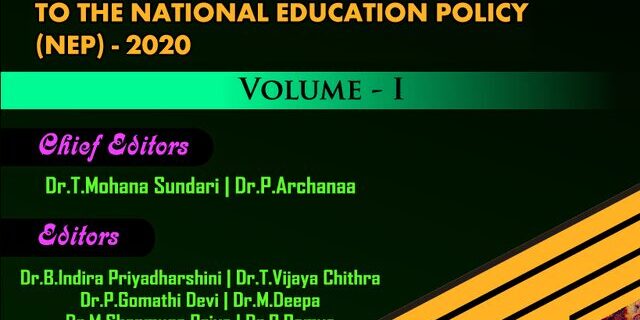
Abstract
The rapid propagation of Artificial Intelligence (AI) demands a drastic shift in educational priorities. NEP 2020 provides the scheme for this transformation, emphasizing the development of human-centric skills that complement, rather than compete with, machine intelligence. The progression of Artificial Intelligence (AI) is reshaping economies, workplaces, and societal structures, compelling a fundamental rethinking of educational paradigms. The National Education Policy (NEP) 2020 recognizes this shift and advocates for competencybased, learner-centric, and future-ready education aligned with 21st century skills. This paper examines the need to redesign pedagogical paradigms in the context of an AI-driven world and analyzes how NEP 2020 provides a strategic framework for fostering critical thinking, creativity, collaboration, communication, digital literacy, and ethical reasoning, within the Indian education framework, aligning with the NEP’s focus on multidisciplinary, holistic education. Adopting a qualitative, conceptual, and policy-analytical research design, the study synthesizes existing literature, policy documents, and global best practices to propose an integrated pedagogical framework aligned with NEP 2020. The paper highlights the role of AI-enabled pedagogies, interdisciplinary learning, experiential education, and assessment reform in nurturing holistic learner competencies. It also discusses implementation challenges, ethical considerations, and implications for educators, institutions, and policymakers. The study concludes that redesigning pedagogy through NEP 2020 is essential for preparing learners to thrive in an AI-driven knowledge society and contributes to ongoing scholarly discourse on education transformation.
- 21st Century Skills
- Artificial Intelligence
- Education Transformation
- Future-Ready Learning
- NEP 2020
- Pedagogical Paradigms
Files
Details
- Date
- 2026
- Language
- English
- Related link (publisher page, OPAC…)
- ngmclibrary.in/item/transforming-education-for-the-ai-era-pedagogical-reforms-and-21st-century-skill-development-in-the-nep-2020-framework/
- Collection
- Conference Papers
Cite this item
Niraimathi, S. (2026). Transforming Education for the AI Era: Pedagogical Reforms and 21st Century Skill Development in the NEP 2020 Framework. https://ngmclibrary.in/handle/ngmcl/2026/00226
Niraimathi, S. “Transforming Education for the AI Era: Pedagogical Reforms and 21st Century Skill Development in the NEP 2020 Framework.” , 2026. https://ngmclibrary.in/handle/ngmcl/2026/00226.
Niraimathi, S. “Transforming Education for the AI Era: Pedagogical Reforms and 21st Century Skill Development in the NEP 2020 Framework.” In . 2026. https://ngmclibrary.in/handle/ngmcl/2026/00226.