
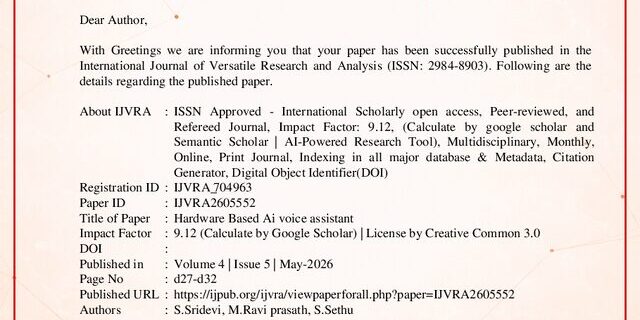
Abstract
This paper presents the design and implementation of a real-time AI voice assistant using ESP32 and cloudbased artificial intelligence. The system captures user voice input through an INMP441 I2S microphone and transmits the audio data to a Python-based server using WebSocket communication. The server processes the audio using Speech-to-Text (STT), generates intelligent responses using AI models, and converts the output into speech using Text-to-Speech (TTS). The system employs Voice Activity Detection (VAD) to identify speech segments and eliminate unnecessary processing of silence or noise, thereby improving efficiency. The final output is played through a Bluetooth speaker, enabling real-time interaction. The proposed system is cost-effective, scalable, and suitable for applications such as smart assistants, IoT automation, and accessibility tools. Experimental results demonstrate that the system achieves accurate speech recognition and response generation with an average response time of less than three seconds under normal conditions.
Files
Details
- Date
- 2026
- Language
- English
- Related link (publisher page, OPAC…)
- ngmclibrary.in/item/hardware-based-ai-voice-assistant/
- Collection
- Journal Articles
Cite this item
Sridevi, S. (2026). Hardware Based AI Voice Assistant. . https://ngmclibrary.in/handle/ngmcl/2026/00131
Sridevi, S. “Hardware Based AI Voice Assistant.” , 2026. https://ngmclibrary.in/handle/ngmcl/2026/00131.
Sridevi, S. “Hardware Based AI Voice Assistant.” (2026). https://ngmclibrary.in/handle/ngmcl/2026/00131.