
Abstract
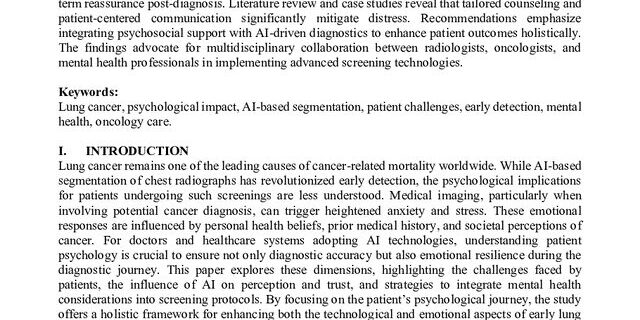
Early detection of lung cancer significantly improves survival rates, yet the psychological dimensions of the diagnostic process remain underexplored. This study investigates the emotional, cognitive, and behavioral responses of patients undergoing early lung cancer screening using AI-based segmentation on chest radiographs. By integrating psychological assessments with technological diagnostics, the research identifies common patient challenges, including anxiety, stigma, decisional conflict, and fear of false positives. Statistical analysis of patient feedback and mental health screenings highlights a notable correlation between early detection methods and elevated short-term anxiety, despite longterm reassurance post-diagnosis. Literature review and case studies reveal that tailored counseling and patient-centered communication significantly mitigate distress. Recommendations emphasize integrating psychosocial support with AI-driven diagnostics to enhance patient outcomes holistically. The findings advocate for multidisciplinary collaboration between radiologists, oncologists, and mental health professionals in implementing advanced screening technologies.
Files
Details
- Date
- 2025
- Language
- English
- Related link (publisher page, OPAC…)
- ngmclibrary.in/item/psychological-dimensions-and-patient-challenges-in-early-lung-cancer-detection-using-ai-based-segmentation-on-chest-radiographs/
- Journal / book / proceedings / newspaper title
- International Journal of Cultural Studies and Social Sciences
- Volume
- 22
- Issue / number
- 2
- ISSN
- 2347-4777
- Collection
- Journal Articles
Cite this item
Malathi Ravindran, R. (2025). Psychological Dimensions and Patient Challenges in Early Lung Cancer Detection Using AI-Based Segmentation on Chest Radiographs. International Journal of Cultural Studies and Social Sciences, 22(2). https://ngmclibrary.in/handle/ngmcl/2026/00704
Malathi Ravindran, R. “Psychological Dimensions and Patient Challenges in Early Lung Cancer Detection Using AI-Based Segmentation on Chest Radiographs.” International Journal of Cultural Studies and Social Sciences, vol. 22, no. 2, 2025. https://ngmclibrary.in/handle/ngmcl/2026/00704.
Malathi Ravindran, R. “Psychological Dimensions and Patient Challenges in Early Lung Cancer Detection Using AI-Based Segmentation on Chest Radiographs.” International Journal of Cultural Studies and Social Sciences 22, no. 2 (2025). https://ngmclibrary.in/handle/ngmcl/2026/00704.