Abstract
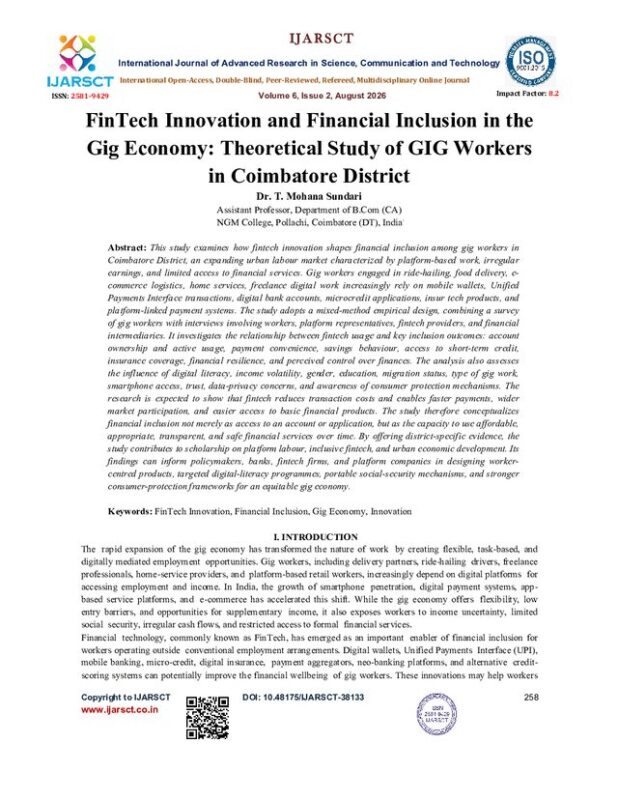
This study examines how fintech innovation shapes financial inclusion among gig workers in Coimbatore District, an expanding urban labour market characterized by platform-based work, irregular
earnings, and limited access to financial services. Gig workers engaged in ride-hailing, food delivery, e-commerce logistics, home services, freelance digital work increasingly rely on mobile wallets, Unified
Payments Interface transactions, digital bank accounts, microcredit applications, insur tech products, and platform-linked payment systems. The study adopts a mixed-method empirical design, combining a survey of gig workers with interviews involving workers, platform representatives, fintech providers, and financial intermediaries. It investigates the relationship between fintech usage and key inclusion outcomes: account ownership and active usage, payment convenience, savings behaviour, access to short-term credit, insurance coverage, financial resilience, and perceived control over finances. The analysis also assesses the influence of digital literacy, income volatility, gender, education, migration status, type of gig work, smartphone access, trust, data-privacy concerns, and awareness of consumer protection mechanisms. The research is expected to show that fintech reduces transaction costs and enables faster payments, wider market participation, and easier access to basic financial products. The study therefore conceptualizes financial inclusion not merely as access to an account or application, but as the capacity to use affordable, appropriate, transparent, and safe financial services over time. By offering district-specific evidence, the study contributes to scholarship on platform labour, inclusive fintech, and urban economic development. Its
findings can inform policymakers, banks, fintech firms, and platform companies in designing worker-centred products, targeted digital-literacy programmes, portable social-security mechanisms, and stronger
consumer-protection frameworks for an equitable gig economy.
Files
Details
- Date
- 2026
- Language
- English
- Related link (publisher page, OPAC…)
- ngmclibrary.in/item/fintech-innovation-and-financial-inclusion-in-the-gig-economy-theoretical-study-of-gig-workers-in-coimbatore-district-2/
- Collection
- Journal Articles
Cite this item
Mohana Sundari, T. (2026). FinTech Innovation and Financial Inclusion in the Gig Economy: Theoretical Study of GIG Workers in Coimbatore District. . https://ngmclibrary.in/handle/ngmcl/2026/00068
Mohana Sundari, T. “FinTech Innovation and Financial Inclusion in the Gig Economy: Theoretical Study of GIG Workers in Coimbatore District.” , 2026. https://ngmclibrary.in/handle/ngmcl/2026/00068.
Mohana Sundari, T. “FinTech Innovation and Financial Inclusion in the Gig Economy: Theoretical Study of GIG Workers in Coimbatore District.” (2026). https://ngmclibrary.in/handle/ngmcl/2026/00068.